Your Resorces
Here you will find information and guidance on how you can help yourself become more productive, healthier and ultimately happier in your own skin.

5 Steps to Forming New Habits and Braking Bad Ones
Habits are a part of our everyday life without even knowing it. A lot of us don’t even release we do these things, whether they are good or bad for example brushing your teeth or putting your seatbelt on when you get in the car. these are all things we just do without having any thought about why or what we are doing. So how do you implement this into a behaviour we want to achieve.
STEP 1
Decide on a Goal
This must be a goal you are strongly committed to. write down why you really want to achieve this and build this habit into your routine. Think big what long term affects is this goal going to be having on your health or mindset.
STEP 2
Chose a Simple Action you can Consistently do
This needs to directly link to your goal and be something you can easily implement into your routine. For example setting your gym clothes out the night before and placing them beside your bed for the morning. Another example is replacing your evening snack with one in the day, to prevent hunger later on.
STEP 3
Pair This with a Cue
Our brains work by connecting a habit to a cue, this is why we often do them automatically for example putting your seatbelt on when you get in the car. So let’s pair a healthy habit with a cue. For example I want to form a habit of going for a small walk after my dinner, my cue for this might be something so simple as putting on my walking shoes or my coat. It sounds silly but I might even so this before I eat my lunch, it is then more effort to tae the shoes off than to actually go for the walk.
STEP 4
Create a Habit loop
I have explained the theory behind the habit loop further bellow but ultimately we must incorporate this cue and action within our routine.
STEP 5
Track your Habits
The formation of sustainable habits requires consistency. Timing them off on a habit tracker such as streaks gives the brain a small hit of dopamine - the reward system of our brains. Streaks is designed to be specifically satisfying to the brain, this keeps you consistent as you are getting a good feeling by completing your daily habits.
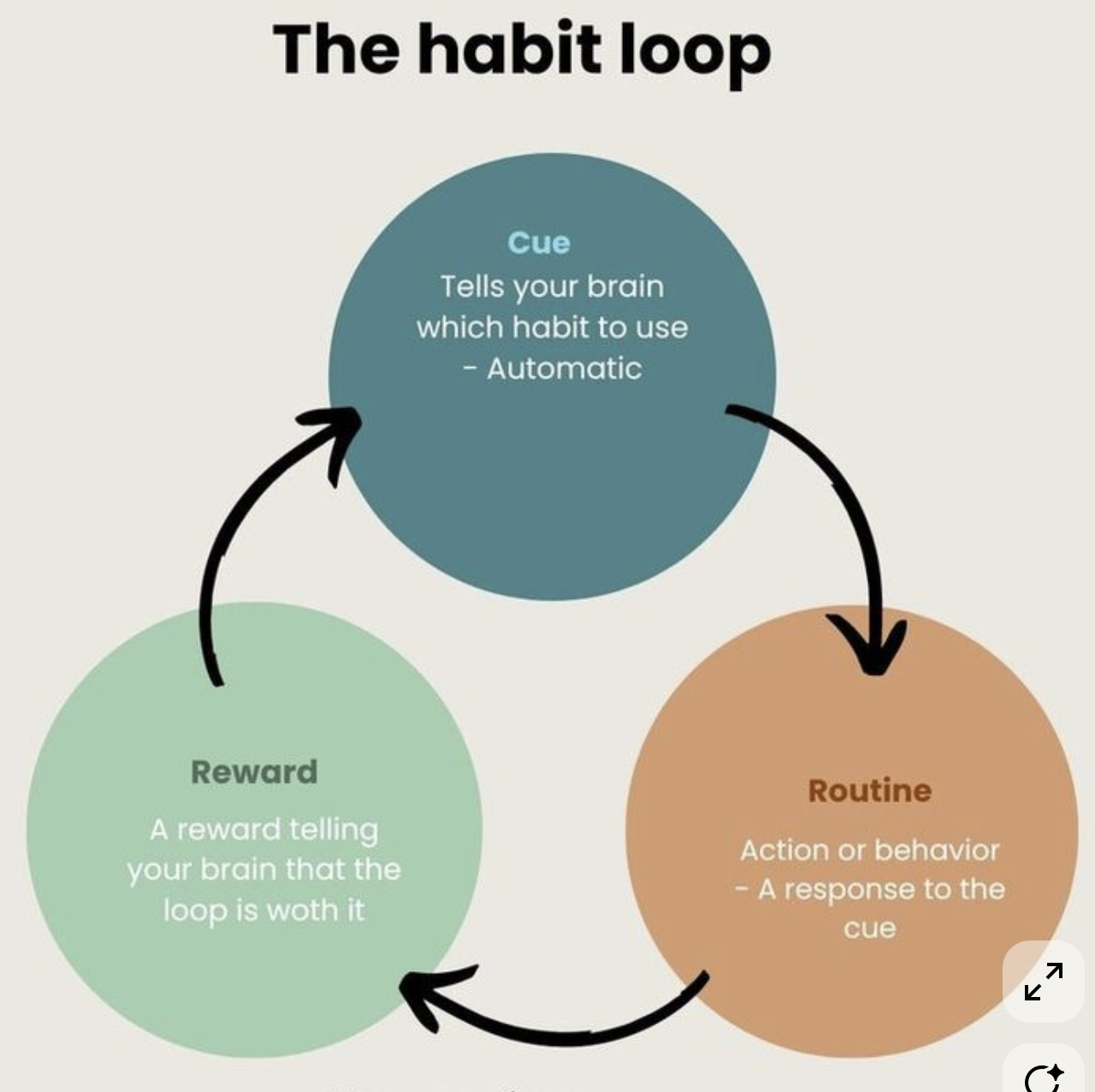
The Habit Loop
The habit loop is the association between the habit, the routine and the cue which is associated with the habit. For example getting in the car is a behavioural cue for putting your seat belt on, likewise getting home from work might be the behavioural cue associated with having a glass of wine.
The Cue tells you brain to do something, a routine is formed as a response to this particular cue, then a reward is received into the brain forming the habit.
So how do we go about changing the loop?
Simple, You Start with the Cue
lets do this together using my example.
I associate finishing my dinner and sitting on the sofa with snacking and I am wanting to change this as snacking close to ben hinders my sleep and therefore recovery.
Firstly, I need to pin point exactly what part of my routine is the cue. For me the cue is after I have cleaned up from dinner made a cup of tea and am sat on the sofa watching a show to wind down from the night. Now how can I alter this cue to ultimately change my routine and therefore my habit?
I need to make a change. instead of making a tea straight after cleaning I am now going upstairs and brushing my teeth after I have eaten, sometimes using mouth wash. This is then followed by a herbal tea and chilling with no snacks. I have formed a new cue within my routine: brushing teeth and mouth wash = no food. the minty taste reduces my cravings for sweet things giving me the ability to control snacking in the evening.
NOTE habits do not form overnight. They are formed by the repetition of behaviours over and over which ultimately connects nerons in our brain by sending signals. Every time we perform the behaviour a neron is connecting the cue to the reward. there times we do this the stronger the habit gets and the stronger we perceive the reward.
You may be thinking what is the reward in this particular habit, this is the tricky part when we are reforming bad habits as they are usually associated with high reward. We have to get a little creative. Think of things you like doing, you ind pleasure in. This may be lighting a candle having a herbal tea or night time drink, performing a night time ritual like a face mask or even something so simple as journaling or reading a book. these occupy your mind as well as satisfying the reward center in your brain. one way in particular to fire up the dopamine reward signal in your brain is simply by ticking off that you have completed the task or the habit you wanted to achieve. Apps such as streaks are particularly designed to be satisfying to the brain, releasing a small hit of dopamine. Eventually your brain will crave this small hit and will learn the only way to get it is by completing there new habit you have formed.